Search marketing vs social media marketing is not a universal choice. Here’s what each approach actually asks of you, and how to choose the one that fits.

“Should I focus on search or social media” isn’t really one question. It’s a bundle of smaller ones: how fast do you need results, how much visibility can you sustain, how much do you enjoy the format each one rewards, and how much risk you’re willing to take on a platform you don’t control. Answering the bundled version tends to produce advice that’s right for nobody in particular. Answering the smaller questions produces an actual decision.
This is a genuine comparison, not a case for one side. Search marketing fits Introverted Wealth’s general preference for lower-pressure systems, and it’s tempting to declare it the obvious winner. That would be dishonest. Social media marketing has real advantages that search doesn’t replicate, and for some readers, some or all of a marketing strategy on social genuinely makes more sense.
It’s also worth separating this from a stereotype that doesn’t hold up: preferring search marketing isn’t evidence of being antisocial, shy, or incapable of networking, and it isn’t the same as being opposed to social media on principle. Plenty of people who are perfectly comfortable on camera or in a comment section still choose search as a primary channel because it fits their business model or their bandwidth better, not because interaction itself is a problem. What follows is a strategic choice, not a personality diagnosis.
What Each Approach Actually Is
Search marketing means creating content designed to answer a question someone is already typing into a search bar. Blog posts are the clearest example, but the same logic shows up elsewhere too: a Pinterest pin built around a specific search term, or a YouTube video titled and described around what someone is actually looking for rather than written to bait a click. YouTube in particular behaves more like a search engine than most people assume. A well-made tutorial or explainer video can keep surfacing in search and recommendations for years, the same way a good blog post does, which puts it closer to search marketing than to the feed-driven, here-today-gone-tomorrow model people usually associate with video. The person finds you because they were looking for something specific, not because they were scrolling and happened to stop.
Social media marketing means building visibility through a platform’s feed, on something like Instagram, TikTok, or Threads: posting content designed to be seen by people who weren’t necessarily looking for you, and relying on the platform’s algorithm to decide how many of them actually see it.
The difference in mechanism is the source of almost every other difference on this list.
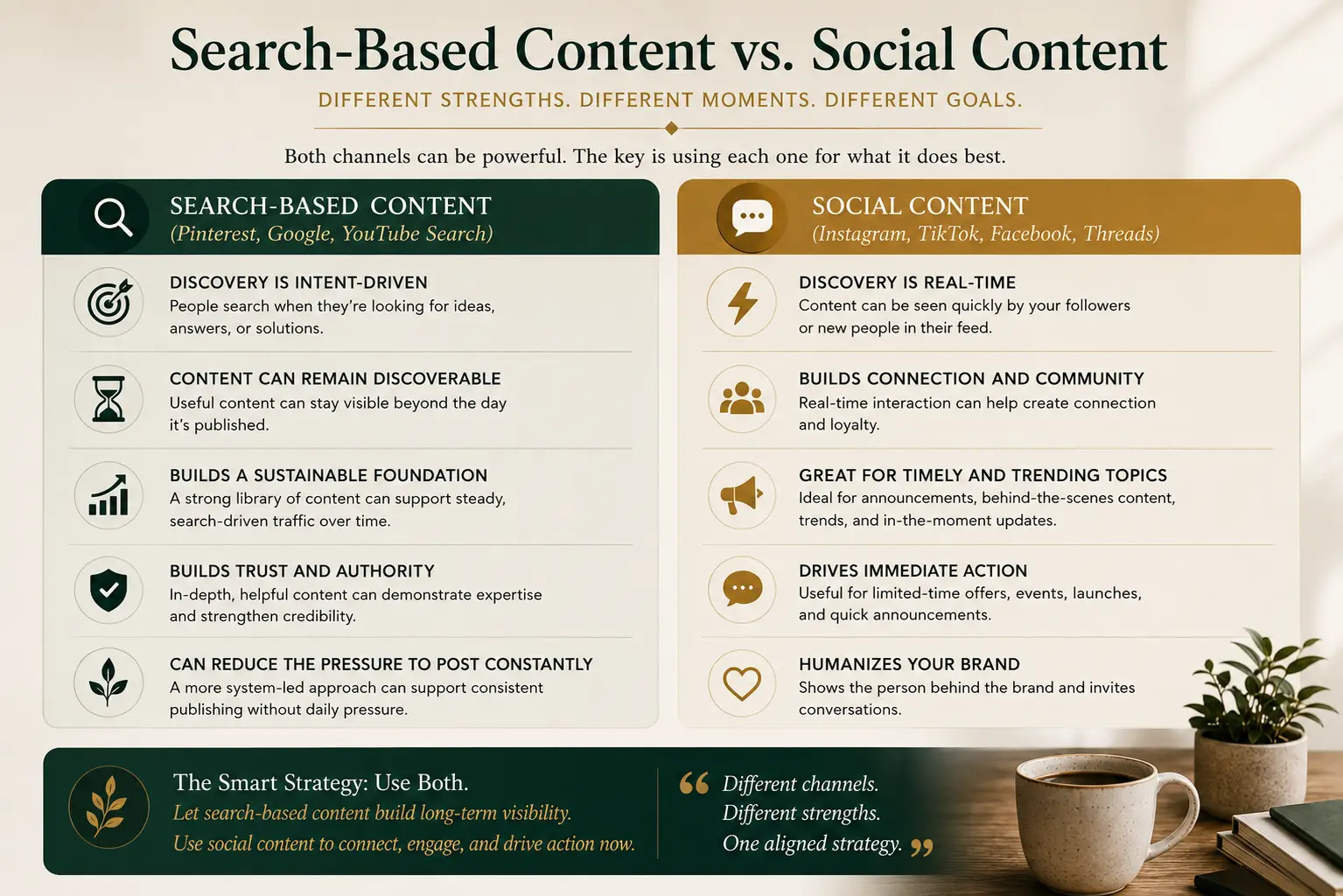
Search Marketing vs Social Media Marketing, Side by Side
| Factor | Search-based | Social-media-led |
|---|---|---|
| Content lifespan | Long. A good post can surface in results for years. | Short. Most posts stop getting meaningful reach within hours to days. |
| Discovery mechanism | Pull: found when someone searches for the specific thing. | Push: shown to people based on algorithmic distribution, not active searching. |
| Posting pressure | Low. A handful of thorough posts can outperform frequent thin ones. | High. Visibility is tied closely to how often and how recently you’ve posted. |
| Visibility required | Low to none. The content can rank without a personal presence attached. | Often moderate to high. Many formats reward a recognizable, consistent presence. |
| Audience relationship | Built through content quality and repeat discovery over time. | Built through direct interaction, comments, and ongoing engagement. |
| Speed of feedback | Slow. Rankings and traffic build gradually. | Fast. Reach and engagement are visible within hours. |
| Compounding potential | High. Older content keeps contributing to total traffic. | Low. Yesterday’s post rarely drives today’s reach. |
| Consistency requirement | Steady output over months, not constant activity. | Frequent, often near-daily activity to stay in the algorithm’s favor. |
| Interaction demands | Minimal; content can work without ongoing engagement. | Regular; comments, replies, and engagement often affect reach itself. |
| Control | High. You own the content and the platform it lives on. | Lower. Reach depends on a platform’s algorithm and policies, which can change. |
| Content format | Favors long-form writing, detailed answers, structured information. | Favors short-form, visual, or highly consumable formats. |
| Platform dependency | Distributed across search engines generally; less tied to one company’s decisions. | Concentrated in a single platform’s rules, reach, and continued existence. |
Where Social Media Genuinely Wins
It’s worth stating plainly: social platforms can produce results search cannot match in certain conditions. A single piece of content can reach a large number of people in hours, something a new blog post essentially never does before it’s had time to be indexed and ranked. Social platforms also make direct, real-time relationship-building possible, in a way that async, search-discovered content doesn’t replicate. For a business built around personality, community, or timely conversation, that’s not a small advantage. It also tends to reward creators who are already comfortable being visible and enjoy the interactive side of it. That’s a real form of leverage, not a consolation prize.
Search-based approaches also aren’t risk-free. Rankings can shift with an algorithm update, and a topic that ranked well can lose position to newer or more authoritative competing content. “More control than social” doesn’t mean “no risk at all.”
How to Actually Choose
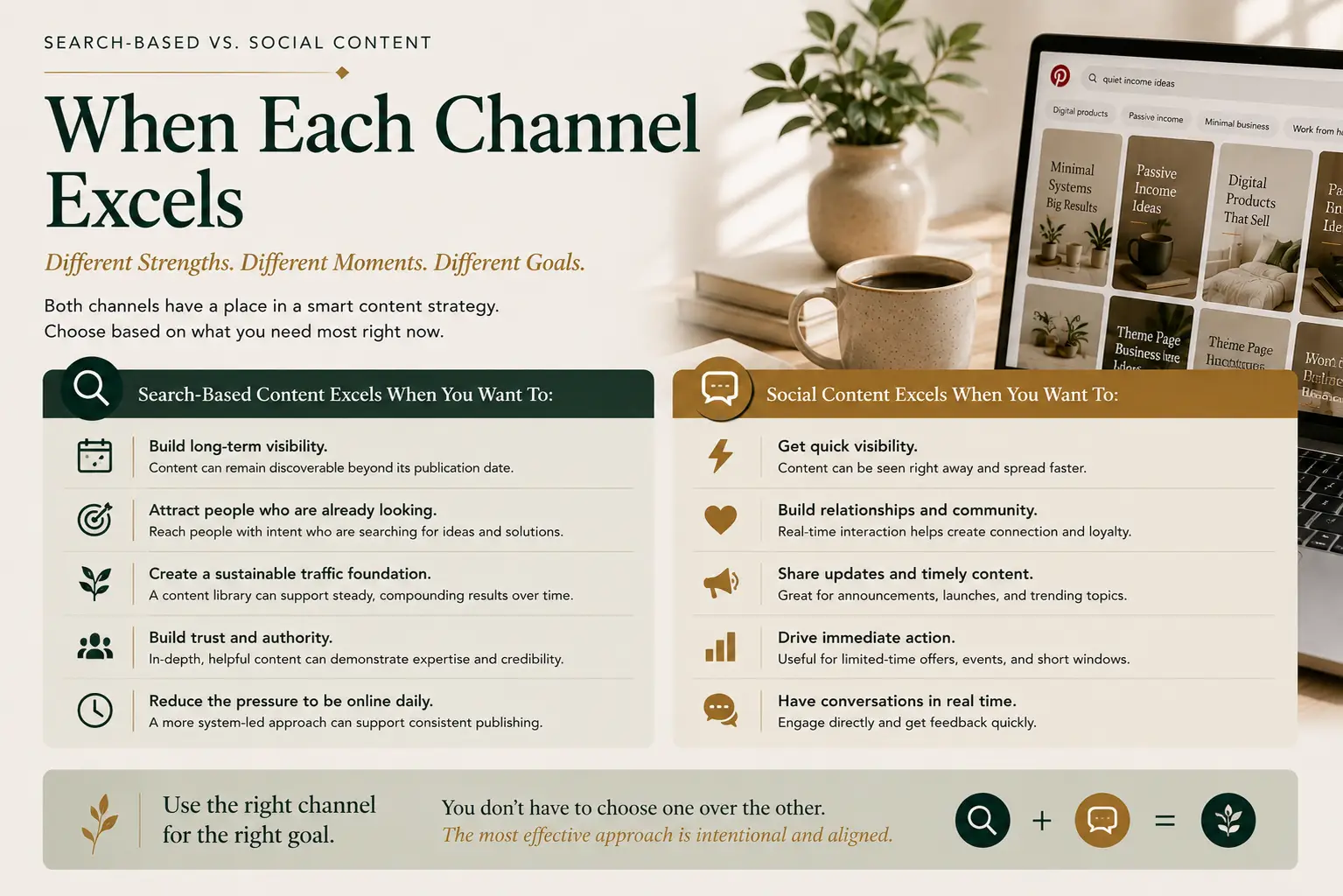
A few questions tend to clarify this faster than a general preference for “quiet” or “loud” does:
What does your business model actually need? A model built on owned, evergreen assets (digital products, a content library) benefits disproportionately from search’s compounding effect. A model built on real-time offers, community, or personal relationship-selling leans harder on social’s speed and interactivity.
How much visibility can you sustain, honestly? Not what sounds appealing in theory, what you can actually keep doing for months without burning out. Search-based work asks for consistency over time; social asks for frequency and presence. The Low Visibility Business Model goes deeper into what “low visibility” actually requires structurally, beyond just picking search over social.
How fast do you need results? If income needs to start moving in weeks, social’s faster feedback loop is a real factor, even with its other costs. If the timeline can absorb a slower build, search’s patience requirement stops being a downside and becomes closer to a feature.
How much do you want to interact, and how often? Search-based work can run with minimal ongoing interaction. Social-led work generally can’t, since reach and interaction are often linked by the platform’s own mechanics.
What are you actually good at making? Long-form written explanation points toward search. Short, visual, or highly consumable formats point toward social. Working against your own natural format, in either direction, tends to be the most expensive way to lose.
The Hybrid Answer
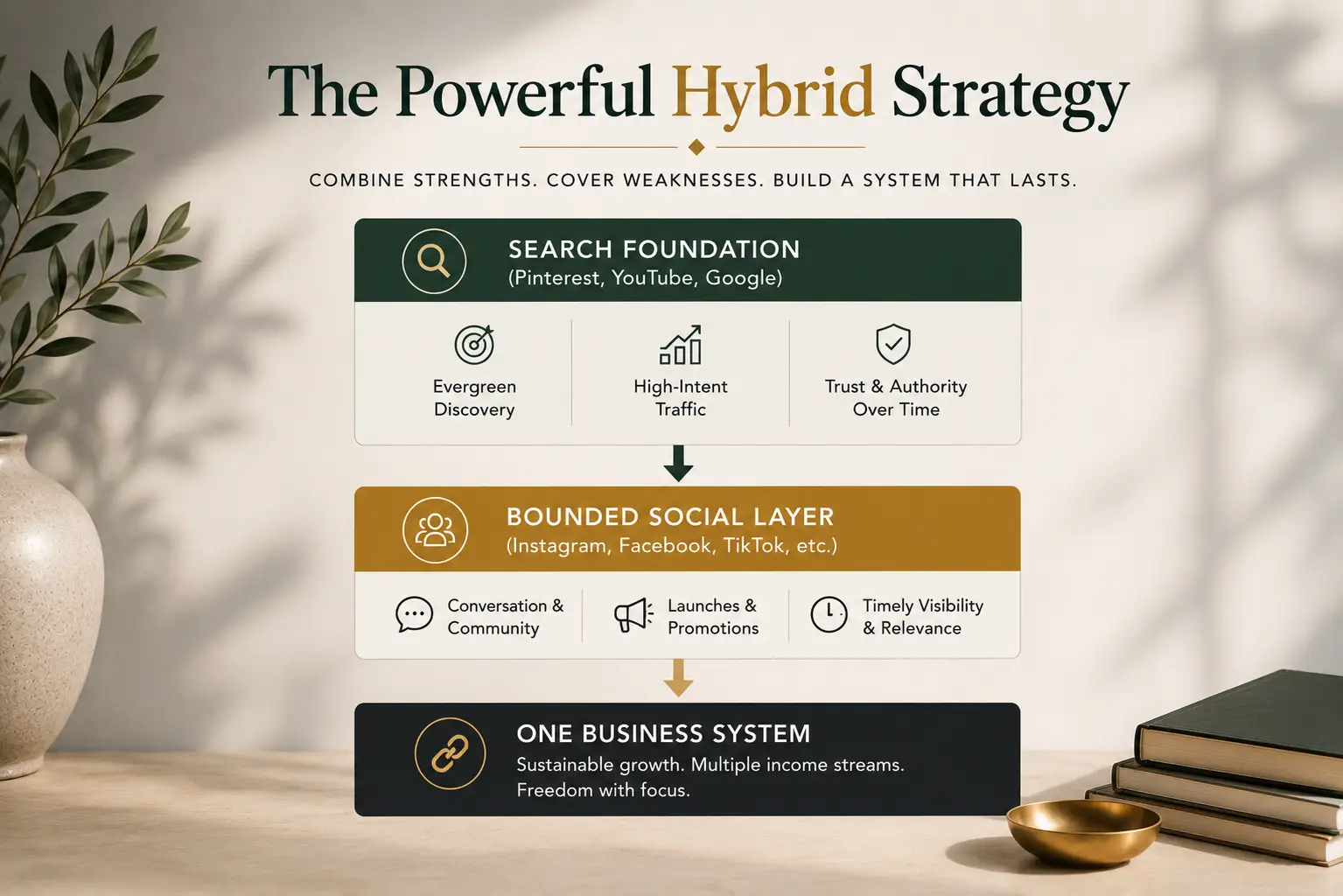
For a meaningful number of people, the right answer isn’t one or the other. A search-based content foundation (a blog, or search-oriented content on a platform like Pinterest) can carry the bulk of long-term discovery, while a lighter, boundaried amount of social activity, posted on a schedule that doesn’t require constant presence, handles the parts search genuinely can’t: real-time connection, faster feedback, and reach into people who weren’t already searching. The mistake isn’t choosing a hybrid. It’s trying to run both at full intensity, which usually means neither gets done well.
Frequently Asked Questions
Is search marketing always the better choice for introverts?
Not automatically. It tends to require less ongoing visibility and interaction, which fits many introverts’ preferences, but “fits typical preferences” isn’t the same as “always correct.” Business model, timeline, and actual content strengths matter more than a general personality fit.
Can I really succeed with almost no social media presence?
Yes, for models built around search-discoverable content or offers. It’s a genuinely viable primary strategy, not a fallback for people who couldn’t manage social media. Some businesses do maintain a minimal, low-frequency social presence alongside it for the reach social alone can add.
How do I know if I’m better suited to search or social, personality aside?
Look at what you’re already good at producing without forcing it: detailed writing points toward search, quick and visual content points toward social. Matching strategy to actual output tends to outperform matching it to a stated preference.
Does choosing search marketing mean I’m avoiding people or networking?
No. It means a particular channel fits a particular business model and working style better than another one does. Plenty of people who choose search as a primary strategy are comfortable networking, being on camera, or engaging on social, and choose search anyway because it asks for less ongoing performance to sustain the same result over time.
Your Next Step
Why Blogging Is Still One of the Smartest Online Businesses for Introverts is the deeper look at search marketing’s most direct implementation, and How Pinterest Can Grow a Faceless Business shows how a search-led approach can work on a visual platform specifically. If you want to work out which acquisition strategy fits your specific business model before committing to either, the Quiet Income Archetype Quiz is built to help narrow that down.