The low visibility business model is not about hiding. It is about choosing where visibility creates value—and removing it where it only creates pressure.
Low visibility does not mean low ambition, low quality, or low earning potential. It means your business is designed so that your face, personality, and daily presence are not the machinery keeping everything moving. Your work can be discoverable without your private life becoming public property.
That distinction matters. Much of today’s online business advice quietly assumes that more exposure is always better: post more, share more, go live more, become the brand. For some founders, that model is energizing. For others—especially introverts and privacy-minded creators—it turns the business into a performance they must continually maintain.
What is a low visibility business model?
A low visibility business model is a way of building income around assets and systems rather than ongoing personal exposure. The brand may be visible. The offer may be highly visible. The founder does not have to be.
Instead of making your personality the main distribution channel, you build useful things that can carry the message: articles, product pages, email sequences, templates, digital products, searchable videos, Pinterest content, and well-organized customer journeys.
The low visibility business model fits naturally with the Quiet Income Blueprint. Quiet income is not income without effort; it is income built with leverage, lower visibility, and a more sustainable demand on your attention.
High visibility and low visibility are different operating systems
The difference is not simply whether you show your face. It is what the business depends on to keep attracting attention and producing revenue.
High-visibility model
- The founder is the primary attention source.
- Frequent posting keeps the audience warm.
- Personal access helps drive trust and sales.
- Momentum may slow when the founder steps away.
- Content often expires quickly in social feeds.
Low-visibility model
- The offer and brand carry the message.
- Searchable assets work beyond posting day.
- Trust grows through usefulness and consistency.
- Systems continue when the founder is offline.
- Content is built to compound over time.
The low visibility business model is not morally superior by default. The right question is whether the model supports the life, energy, and boundaries you want. If a business only works when you are constantly available, it has not yet separated your income from your presence.

The seven parts of a low visibility business
A clear problem and promise
A low visibility business model works best when the offer is easy to understand. Your audience should know who it helps, what it improves, and why it is worth choosing without needing hours of personal storytelling first.
An asset-led offer
Digital products, templates, guides, resource libraries, memberships, affiliate content, print-on-demand products, and other structured offers can deliver value without requiring you to be present for every transaction.
Search-based discovery
Google Search, Pinterest, blogs, and searchable YouTube content help people discover useful work when they are already looking for an answer. This is different from repeatedly interrupting a social feed and hoping attention turns into interest.
Brand-led trust
Trust can come from clear writing, thoughtful design, useful examples, transparent policies, proof, and a consistent customer experience. You do not need to disclose everything about yourself to prove that your business is real.
An owned audience path
Your website and email list give people a direct route back to you. They reduce the risk of depending entirely on a platform whose reach, rules, or trends can change without warning.
Automated delivery
Payment, onboarding, product delivery, follow-up, and basic support should be organized wherever practical. Automation does not remove care; it removes avoidable repetition.
Intentional visibility
You can still choose interviews, a podcast, selective social posts, a founder note, or occasional face-forward content. The difference is that these become choices that strengthen the business—not obligations required to keep it alive.

What low visibility does—and does not—protect
| Area | What the model changes | What still matters |
|---|---|---|
| Privacy | You decide how much personal information becomes public. | Your business still needs honest policies and clear communication. |
| Energy | Fewer tasks depend on live performance and constant access. | You still need focused creation, maintenance, and customer care. |
| Marketing | Evergreen and searchable assets do more of the discovery work. | You still need distribution, optimization, and a relevant offer. |
| Income | Systems can reduce the direct link between every hour and every sale. | Results still require testing, useful assets, and patience. |
| Authority | Expertise is demonstrated through the quality of the work. | Credibility, accuracy, and proof remain essential. |
This is why the low visibility business model should not be confused with anonymity at all costs. A business can be transparent without being personally exposed. Customers need to know what they are buying, what they can expect, and how to get help. They do not need unrestricted access to the founder.
Why this model can be more sustainable for introverts
Introverts are not incapable of visibility. Many are excellent speakers, teachers, hosts, and leaders. The issue is usually not competence; it is the cost of making constant visibility the default.
When the low visibility business model is built around deeper work, thoughtful communication, and repeatable systems, the founder can use visibility in concentrated moments and recover without the entire marketing engine going silent. That creates more room for product quality, strategy, customer understanding, and the kind of focused work that often produces the strongest long-term advantage.
If privacy is one of your central concerns, read How to Stay Private and Still Build Income Online. If you have been told that your personality must become the product, You Don’t Need a Personal Brand to Make Money Online explains the alternative.

How to begin shifting toward lower visibility
You do not need to rebuild everything at once to adopt a low visibility business model. Begin by identifying where your business currently depends on repeated personal effort. Then replace one fragile dependency at a time.
Turn a repeated explanation into a useful article. Turn a manual welcome message into an email sequence. Turn a one-time idea into a searchable resource. Turn scattered content into a clear product path. Turn constant posting into a smaller number of durable assets that answer real questions.
When choosing between models, compare more than revenue potential. Compare the energy required, how quickly the content expires, whether you own the audience relationship, and what happens when you step away. The comparison in Active Income vs Passive Income vs Quiet Income can help you see those trade-offs more clearly.
Your business should work with your nature.
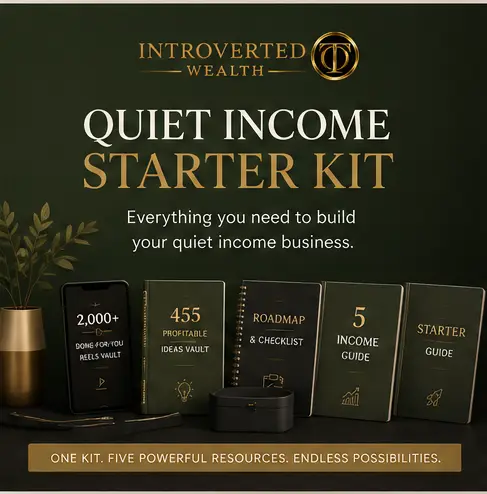
Use the Business Match Assessment to identify the income path that best fits your visibility, energy, and working style. Then use the Quiet Income Starter Kit to turn that direction into a practical plan.
The goal is strategic visibility
Low visibility, done well, is not about disappearing. It is about deciding—on purpose—which parts of your business speak for you: the problem you solve, the value you create, the experience you deliver, and the path a customer can take next.
Your private life can remain private. Your work can still travel. Your brand can still become recognizable. And your business can grow around assets that do not require you to perform every day.