Digital Products:
The Best Quiet Income Business Model?
“Create it once, sell it forever” is an attractive promise. The real model is more demanding—and far more useful to understand.
ONCE.CREATE · VALIDATE · LEVERAGE
At a glance
Digital products for introverts can become a strong low-visibility income model: no physical inventory, no ongoing personal exposure, and one asset that can sell repeatedly. The trade-off is front-loaded work—validation, usefulness, positioning, and discovery still determine whether it sells.
Create once, sell forever” is the line that sells the dream of digital products, and it’s also the reason so many first attempts stall out. It implies the hard part is the creating, and once that’s done, the selling just happens. In practice, it’s closer to the reverse: creating something small enough to finish is usually the easy part. Getting it in front of people who actually need it, and making the case that it’s worth paying for, is where the real work lives.
None of that means digital products are a bad model—they can be one of the strongest low-visibility income paths available, especially for someone who doesn’t want to build a business around constant visibility. It simply means the honest version looks different from the version in most income-report screenshots.
What a digital product business actually is
A digital product is something you create once — a template, guide, tool, planner, or system — and sell repeatedly without producing a new unit for each sale. There’s no shipping, no inventory, and no live delivery required. The buyer pays, and the file, link, or access is delivered automatically. That’s the entire mechanical definition. Everything else — what makes one succeed and another sit unsold — comes down to whether it solves a problem someone was already looking to solve.
Why Digital Products for Introverts Make Sense
Digital products for introverts work well for a specific reason: nearly everything about the model can happen without another person in the room.
- It can be created independently. No team, no client calls, no collaborator required to get from idea to finished product.
- It doesn’t require constant visibility. Your face, voice, and daily presence are optional — the product does the talking.
- It can use search-based traffic. A blog post, Pinterest pin, or SEO-optimized page can bring in buyers without you posting every day.
- There’s no physical inventory. Nothing to store, pack, or ship — the entire fulfillment process is automatic.
- Delivery is automated. Once it’s set up, a sale at 2 a.m. gets fulfilled without you doing anything.
- One asset can be sold repeatedly. The tenth sale costs you the same effort as the first: none.
Put together, this is what makes digital products a genuinely low-visibility, low-maintenance model once it’s built. The key phrase there is once it’s built — because building it is where the real work is.
What the model still genuinely requires
This is the part most “passive income” content skips, and it’s the part that determines whether your first product actually sells:
- Validating the problem. Confirming people actually want this solved — not assuming they do because you’d find it useful.
- Creating a useful solution. Not just a finished file, but one that genuinely delivers the outcome it promises.
- Positioning. Explaining clearly who it’s for and what it does, so the right person recognizes it as theirs immediately.
- Traffic generation. Getting the product in front of people — through search, Pinterest, content, or existing channels.
- Conversion. Writing a product page and offer that actually gets someone to complete a purchase, not just browse.
- Customer support and updates. Answering questions, fixing issues, and keeping the product current as things change.
None of this is discouraging — it’s just accurate. A digital product removes the burden of constant content and personal exposure. It does not remove the burden of doing real, useful work to earn a sale.
Seven beginner-friendly digital product categories
If you’re deciding where to start, these are approachable entry points that don’t require advanced technical skill or a large existing audience:
- Templates and printables — planners, trackers, checklists, or worksheets solving a specific, recurring task (budget templates, meal planners, goal-setting worksheets).
- Guides and workbooks — a written walkthrough of how to do something specific, with clear steps rather than general advice.
- Canva or Notion systems — pre-built templates inside tools people already use, so there’s no new software to learn.
- Digital planners and trackers — recurring-use tools (habit trackers, content calendars, project planners) that people return to often, which builds word-of-mouth.
- Stock creative assets — fonts, graphic packs, social media templates, or design elements other creators use in their own work.
- Mini-courses or short trainings — a focused lesson on one narrow skill, rather than a sprawling, all-in-one course.
- Swipe files and prompt packs — pre-written templates (email scripts, captions, prompts) that save the buyer the work of writing from scratch.
Notice what these have in common: each one solves a specific, nameable problem. That’s not a coincidence — it’s the difference between a product that sells and one that doesn’t.
A product-idea validation checklist
Before committing real time to an idea, run it through these questions:
- Is there a real audience already searching for a solution to this — in forums, search terms, or existing paid products?
- Does a free or cheaper alternative already solve this well enough that mine needs a clear reason to exist?
- Can I explain the transformation this creates in one plain sentence?
- Do I have direct experience or observed insight into this specific problem — not just general interest in the topic?
- Could a genuinely useful first version be finished in a realistic timeframe, without needing to be exhaustive?
If most of these check out, the idea is worth developing further. If several don’t, it’s worth adjusting the idea — not abandoning the model. This validation-first approach is the whole premise behind Rob Fitzpatrick’s The Mom Test — asking about specific past behavior instead of hypothetical future interest, so the answers you get are actually reliable.
Is this the right first model for you?
Digital products tend to fit well when you have some existing expertise or lived experience in a specific area, some time to invest before earning anything back, a decent sense of what a particular audience struggles with, and a willingness to handle some complexity up front — writing, basic design, and setting up a simple sales page or listing.
If none of that describes where you are right now — if you’re short on time before you need income, or you don’t yet have a clear sense of who you’d be creating for — that’s useful information, not a dead end. A different starting model, like an asset-based path that doesn’t require creation from scratch, or simply spending more time observing a specific audience’s questions before building anything, may be the better first move. Digital products can always become your second model once you’ve built more clarity.
When digital products are—and are not—the best first move
Best fit: you understand a specific recurring problem, can invest time before earning, prefer front-loaded creation to constant delivery, and are willing to learn basic positioning and traffic.
Poor fit right now: you need income immediately, have no evidence of the problem, dislike creating or updating assets, or expect the platform to find buyers without a discovery plan.
Choose the smallest useful format
Match the format to the buyer’s urgency and your strongest skill: use a checklist for a repeated decision, a template for a repeated task, a short guide for a confusing process, and a mini-training only when demonstration is essential. Choose the format with the lowest support burden that can still deliver the promised result.
Example: instead of starting with a broad course for new freelancers, notice repeated questions about preparing a first client call. Evidence appears in forum threads and reviews. The smallest useful product becomes a client-call preparation template with a clear promise: arrive with the right questions and leave with an actionable brief. Validation begins by showing the outline to five people with that exact problem before designing it.
Post-sale reality: automated delivery removes fulfillment, not responsibility. Budget time for buyer questions, occasional refunds, link or format problems, and periodic updates when tools or examples change.
Your next step: validate, don’t build
The goal today isn’t to build an entire product. It’s to take one small validation step: pick one idea, run it through the checklist above, and spend thirty minutes looking for evidence that people are already asking for this — in search results, forums, or existing products with reviews. If the evidence is there, you have a direction worth developing. If it isn’t yet, that’s a faster, cheaper thing to learn now than after weeks of building.
Frequently Asked Questions About Digital Products for Introverts
Do I need to be an expert to sell a digital product?
No. You need direct experience with the specific problem you’re solving, or careful research into it — not credentials. Many successful digital products come from people who solved a problem for themselves first and packaged the process for others.
How much does it cost to start?
Digital products generally have one of the lowest startup costs of any online business model — often just the tools you may already have (Canva, a word processor) and a place to sell, without inventory or shipping costs.
Can I sell digital products without ever showing my face?
Yes. Nothing about the model requires your face, voice, or identity to be public. Positioning, product pages, and search-based discovery can all work without personal visibility.
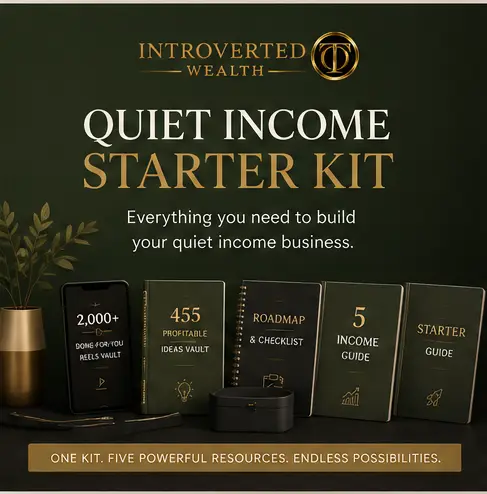
Once you’ve validated a direction, the 455 Digital Product Idea Vault is built for exactly this stage — a structured way to shortlist a specific, in-demand idea instead of starting from a blank page. And if you’re still mapping out your broader direction before committing to digital products specifically, the Quiet Income Starter Kit walks through five quiet income systems side by side so you can see how this one compares.
Related reading
- The Quiet Income Blueprint — the framework behind Low Visibility + Low Energy + Leverage.
- Choosing the Right Quiet Income Business Model — compare digital products against every other quiet income path.
- Biggest Mistakes New Digital Product Creators Make — the beginner errors that quietly sink first launches.