You don’t need an audience to begin. You need five specific things, built in a specific order. Most people who feel stuck have skipped straight to the wrong one.
Most online business content assumes a starting point you don’t have. A following. A camera you’re comfortable in front of. Some existing platform where people already know your name. Skip past that assumption and a lot of advice simply stops applying. That’s how a person ends up feeling disqualified from something they haven’t even tried yet.
Here’s the direct answer: you don’t need a camera or an existing audience to start an online business. You need a person or problem worth serving, a business model suited to how you actually want to work, something useful to offer that person, a way for them to find it, and a simple path from finding it to trusting it to buying it. None of those five things require visibility. All five require actual work.
That distinction matters, because “you don’t need an audience” gets misread as “you don’t need to do anything.” You do. You just don’t need to perform to do it. What follows is the order those five pieces usually need to happen in, and what each one looks like when you’re starting from exactly nothing.
Why “Where Do I Start?” Feels So Hard to Answer
Part of the problem is that most starting advice is organized by idea (a list of business models, a list of products, a list of platforms) instead of by sequence. Ideas are useful once you know what order to build in. Handed to someone before that, a list just becomes forty new tabs and no first move.
The other part is that visibility-first advice trains people to think the audience comes before the offer. Post consistently, grow a following, then figure out what to sell it. That order works for some people. It also requires tolerating a kind of ongoing exposure that a lot of introverts find genuinely costly: not impossible, just expensive in a way that makes starting feel harder than it needs to be.
There’s a different order. It starts with a person, not a platform. The Quiet Income Blueprint lays out the full framework this sequence sits inside; this article is the five-step version for the exact moment of starting.

Step One: Find a Person or a Problem Worth Serving
Every business, loud or quiet, exists because someone has a problem they’d pay to have solved, or a want they’d pay to have met. Before a model, a product, or a platform, that’s the actual starting point. It’s the step that’s easiest to skip because it doesn’t feel like “doing” anything.
You don’t need original research or a market report. You need specificity. “People who want to make money online” isn’t a person with a problem; it’s the entire internet. “Someone who just started freelancing and has no idea how to price their first few projects” is a person with a problem. The second version tells you what to build and who it’s for. The first tells you nothing.
A useful way to find this: think about a problem you’ve already solved for yourself, recently, without much fanfare — a system you built, a mistake you stopped making, a question you finally answered. Chances are you’re not the only person who had it.
Step Two: Choose a Business Model That Fits How You Want to Work
Once you know roughly who you’re serving, the next decision is how. This is where a lot of people accidentally choose based on what looked easiest on someone else’s feed rather than what actually fits their energy, visibility comfort, and available time.
This isn’t the article to walk through every model option; Choosing the Right Quiet Income Business Model and Digital Products: The Best Quiet Income Business Model? already do that in depth. What matters here is the order: model comes after person, not before. Choosing “digital products” or “a service” or “affiliate content” in the abstract, before you know who you’re serving, is how people end up with a business model and no one to use it.
Step Three: Build Something Useful, Not Something Impressive
The instinct at this stage is often to overbuild: a full course when a two-page guide would do, a polished brand when a plain answer to one specific question would sell faster. Starting from zero actually works in your favor here — nobody’s watching yet, which means the pressure to make something impressive is lower than it will ever be again.
The first useful thing you make doesn’t need to be comprehensive. It needs to solve the specific problem from Step One, clearly enough that the person it’s for could use it without needing you to explain anything further. A checklist that removes one recurring decision. A short guide that answers the exact question people are already typing into a search bar. A template that saves someone two hours they’d otherwise spend guessing.
Small and finished beats ambitious and unfinished. You can build something larger once you know the first thing actually helped someone.
Step Four: Give People a Way to Find It Without Following You
This is the step “no audience” advice usually skips, because it’s the one that actually requires a mechanism. You don’t need followers to be found, but you do need discoverability, and discoverability isn’t automatic. It’s built.
Search is the most common no-audience discoverability mechanism, because it doesn’t require anyone to know you exist beforehand: it requires your content or your listing to answer a question someone is already asking. That’s blog content, that’s a well-titled product listing on a marketplace, that’s a Pinterest pin someone finds eleven months from now while searching for something specific. Why Small Audiences Often Make More Money goes deeper into why reach and relevance aren’t the same thing.
The honest caveat: search-based discovery is not instant. Content takes time to index and rank — Google’s own documentation on crawling and indexing is a useful primer on why. A new listing takes time to accumulate the signals that make it visible. This step is slower to compound than visibility-first growth in the very beginning. It becomes more durable once it starts working, because it keeps working without you repeating a performance every day.
Step Five: Build a Simple Path From Discovery to Trust to Offer
Someone finding your content or listing is not the same as someone buying from you. Between those two moments there’s usually a small trust gap, and closing it doesn’t require a personal brand or a face — it requires clarity.
In practice, that path is often just: someone finds a genuinely useful free piece of content, that content answers their question well enough that they trust the source behind it, and somewhere in or after that content is a clear, low-pressure next step. No hard sell, no scarcity countdown, just a next step that makes sense given what they just got value from. You Don’t Need a Personal Brand to Make Money Online covers what replaces personal-brand trust when there’s no face attached to build it: consistency, usefulness, and follow-through, demonstrated instead of narrated.
What This Looks Like Put Together
A version of all five steps, condensed: someone notices freelancers keep asking the same pricing question in a Facebook group (person and problem). They decide a digital product fits how they want to work — no calls, no delivery labor after the sale (model). They build a short, specific pricing guide with real number ranges by project type (offer). They publish it as a blog post that answers the exact question people are searching, with the guide available inside it (discoverability). Readers who find the post get real value from it first, and the guide is offered at the end as the deeper, keepable version (path to trust to offer).
Nothing in that sequence requires a following. Nothing in it requires a camera. Every piece of it requires actual effort: writing something specific, publishing it somewhere findable, and being genuinely useful before asking for anything back.
Frequently Asked Questions
Can you really start an online business with zero followers?
Yes — audience and discoverability aren’t the same thing. An audience is people who already know you; discoverability is a mechanism, like search, that lets new people find you without knowing you first. You need the second one to start. The first one can build over time, or never need to exist at all.
Do I need to show my face to build trust with customers?
No. Trust can come from a face, or it can come from clarity, consistency, and a genuinely useful free piece of content that proves you know what you’re talking about. It’s common for Quiet Income businesses to run entirely without a visible founder.
What should I build first if I don’t know my “niche” yet?
Start with a problem you’ve already solved for yourself, recently and specifically. It’s easier to build something useful for a problem you understand from the inside than to invent an audience first and guess what they need.
Your Next Step
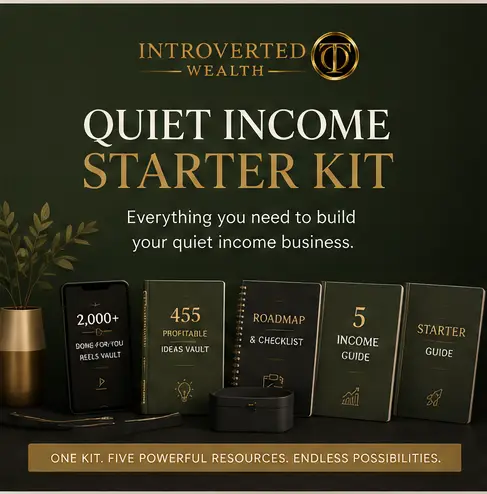
If this sequence makes sense but you want it laid out as an actual plan instead of an article, the Quiet Income Starter Kit walks through these same five pieces as a Roadmap & Checklist and a 7-Day Strategy Plan — the version of this you can follow day by day. If you’re still not sure which business model fits Step Two, the Quiet Income Archetype Quiz is a faster way to narrow that down before you build anything.