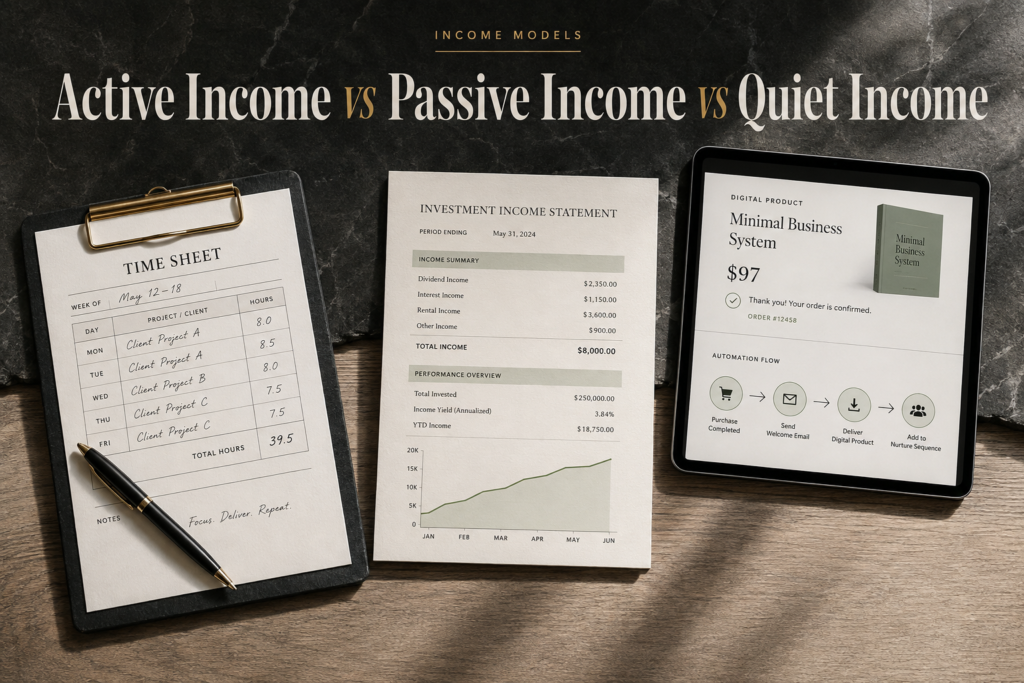
Active income vs passive income vs quiet income is not simply a comparison of how much work each model requires. They describe different relationships between your time, your energy, and the way money is earned. Understanding that difference can help you choose a business model that fits your actual life—not one that only looks impressive online.
Most conversations compare active income with passive income. One requires ongoing work; the other supposedly keeps paying after the work is done. But that comparison leaves out something important: the personal cost of staying visible, available, and constantly engaged.
That is where quiet income belongs in the conversation. Quiet income is designed around low visibility, low energy demands, and leverage. It does not promise money without effort. It asks a better question: Can the work continue creating value without requiring you to perform every day?
Most guides treat active income vs passive income as the whole conversation, then leave quiet income out entirely. But once you compare active income vs passive income vs quiet income side by side, the differences in visibility, energy, and control become obvious. That comparison—active income vs passive income vs quiet income—is really what this article walks through next.
What is active income?
Active income is money earned through work you must continue doing. When the work stops, the income usually stops too. A salary, hourly job, consulting engagement, freelance project, coaching call, or done-for-you service can all produce active income.
There is nothing inherently wrong with active income. It is often the fastest way to earn because the path from effort to payment is direct. You provide a service, complete a task, or exchange your time and expertise for money.
- Main advantage: faster and more predictable cash flow
- Main limitation: income remains closely tied to your availability
- Energy pattern: recurring delivery, communication, and deadlines
- Examples: employment, freelancing, consulting, coaching, client services

What is passive income?
Passive income is money generated with limited ongoing participation after an initial investment of work or capital. Examples can include investment income, royalties, licensing, rental income, or automated product sales.
The word passive is often misunderstood. For tax purposes, the IRS defines passive activities more narrowly, generally around material participation; this article uses the broader everyday business meaning. Most passive-income systems still require something: creation, capital, maintenance, customer support, traffic, optimization, or occasional updates. The income may become less dependent on each working hour, but the system is rarely completely hands-off.
- Main advantage: stronger separation between time worked and money earned
- Main limitation: usually requires upfront work, capital, patience, or all three
- Energy pattern: heavier setup followed by lighter maintenance
- Examples: royalties, investments, licensing, evergreen digital products
What is quiet income?
Quiet income is income built through low-visibility, low-energy, leveraged systems. It focuses not only on whether earnings are detached from time, but also on whether the business can operate without constant personal exposure or social availability.
Quiet income may be active, semi-passive, or increasingly passive at different stages. A digital product takes active effort to create. A blog requires consistent editorial work. An affiliate content system needs research and updates. What makes these models quieter is that they can be built around assets and systems instead of constant access to you.
If you want the full foundation, read What Is Quiet Income? and the Quiet Income Blueprint.
| Income type | What earns the money | Ongoing visibility | Time relationship |
|---|---|---|---|
| Active income | Your continuing labor or expertise | Often moderate to high | Closely tied to hours and availability |
| Passive income | Capital, ownership, or an established asset | Varies | Less tied to each hour worked |
| Quiet income | Low-visibility assets and leveraged systems | Intentionally low | Designed to become less dependent on daily presence |

Active income vs passive income: the real difference is dependency
All three income types can require real work. The more useful distinction is what the income depends on.
That is the real shorthand for active income vs passive income: active income depends on your continued effort, while passive income depends on an asset you already built. Quiet income borrows from both sides of active income vs passive income, but adds a third condition—low visibility—that neither term fully captures.
- Does it depend on you showing up at a particular time?
- Does it depend on clients having direct access to you?
- Does it depend on your face, personality, or daily content?
- Does it depend on an asset that can be found, purchased, or used without you being present?
- Can the process be documented, automated, delegated, or repeated?
A business becomes more leveraged when the asset does more of the work. A search-optimized article can bring visitors long after publication. A digital product can be delivered automatically. An email sequence can guide a reader without a live sales call. A faceless brand can create trust through useful information and consistent design rather than nonstop personal exposure.
Can active income become quiet income?
Yes. You do not have to abandon active income to build a quieter business. In fact, active income can provide the cash flow, experience, and customer insight needed to create leveraged assets later.
A freelancer might turn a repeated process into a template pack. A consultant might convert common client questions into a paid resource. A designer might license assets. A service provider might replace some one-to-one delivery with a self-guided system.
The goal is not to label every dollar perfectly. The goal is to reduce unnecessary dependency on your time and nervous system.
Which income type is best for introverts?
The best choice depends on your current needs. If you need income quickly, active work may be the most practical starting point. If you have capital and a long time horizon, traditional passive-income assets may play a larger role. If you want to build an online business without becoming its full-time public face, quiet income offers a useful design principle.
When comparing active income vs passive income, many introverts do best with a blend:
- Use active income for stability. Keep or develop a reliable income source while building.
- Create one leveraged asset. Start with a focused digital product, resource, or search-based content system.
- Build discovery that compounds. Use Google, Pinterest, YouTube search, or evergreen partnerships instead of relying only on daily social posting.
- Automate the predictable steps. Delivery, email follow-up, onboarding, and basic support can often be systemized.
- Reduce visibility by design. Decide what truly requires your presence and what can be communicated through the brand.

A simple decision test
Before choosing a model, ask yourself four questions:
- How soon do I need this to produce income?
- How much time, money, and energy can I invest upfront?
- How much direct access do I want customers to have to me?
- Can this model create an asset that keeps working after the initial effort?
Your answers may point to a combination rather than a single category. That is normal. A sustainable business can begin with active income and gradually become quieter as you create assets, automate delivery, and move toward search-based discovery.
The quiet-income advantage
Passive income focuses on reducing labor. Quiet income expands the goal: reduce unnecessary visibility, social demand, and dependence on your daily energy while building something valuable.
That distinction matters because a business can be profitable and still be exhausting. It can be automated and still require constant attention online. It can look flexible from the outside while keeping its owner mentally occupied all day.
Quiet income is not the absence of work. It is the deliberate use of leverage so your work can travel farther than your presence.
Your next step
Start building around your energy
If you want a practical way to identify the right model, begin with the Quiet Income Archetype Quiz. It will help you understand the type of system that best matches how you think, work, and make decisions.
Next, read Why Quiet Income Is Better for Introverts to see why this approach is especially useful for people who value privacy, depth, and sustainable energy.