Pinterest for a faceless business works differently from ordinary social media. Here’s what the platform can actually do, what it cannot do, and how to use it without constant visibility.

A faceless business runs on content, offers, and systems instead of a personal brand attached to a face and a voice. That works well until it hits the same wall most quiet businesses hit: how does anyone find it without a founder posting, appearing on camera, or building a following around themselves? Pinterest is one of the more direct answers to that question, not because it’s trendy, but because of how the platform actually functions. Pinterest itself has described the platform as a “visual search engine,” and its own product history backs that up, with a sustained shift toward visual search and discovery tools over the years rather than the interactive, follow-and-scroll design its early “boards and pins” framing suggested. That distinction is the whole reason this article exists: a search engine and a social feed reward completely different strategies, and Pinterest behaves far closer to the former.
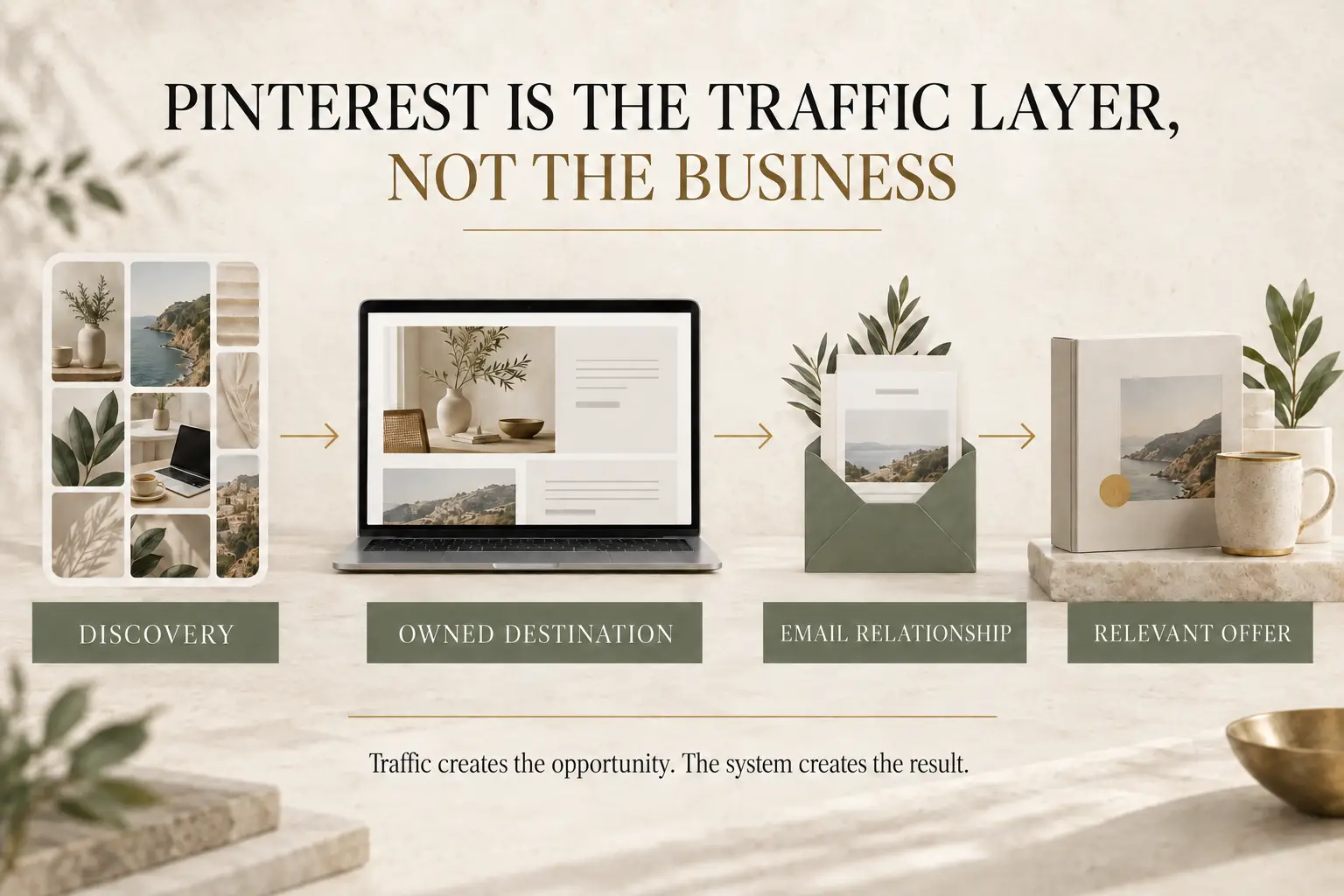
One thing worth being precise about before anything else: Pinterest is a traffic and discovery channel, not a business model on its own. It doesn’t sell anything by itself. It sends people toward something that does, a blog, a product page, a lead magnet, an email list, which is exactly why it fits so naturally into a faceless business built around owned assets rather than a personal audience.
Why Pinterest for a Faceless Business Works Differently
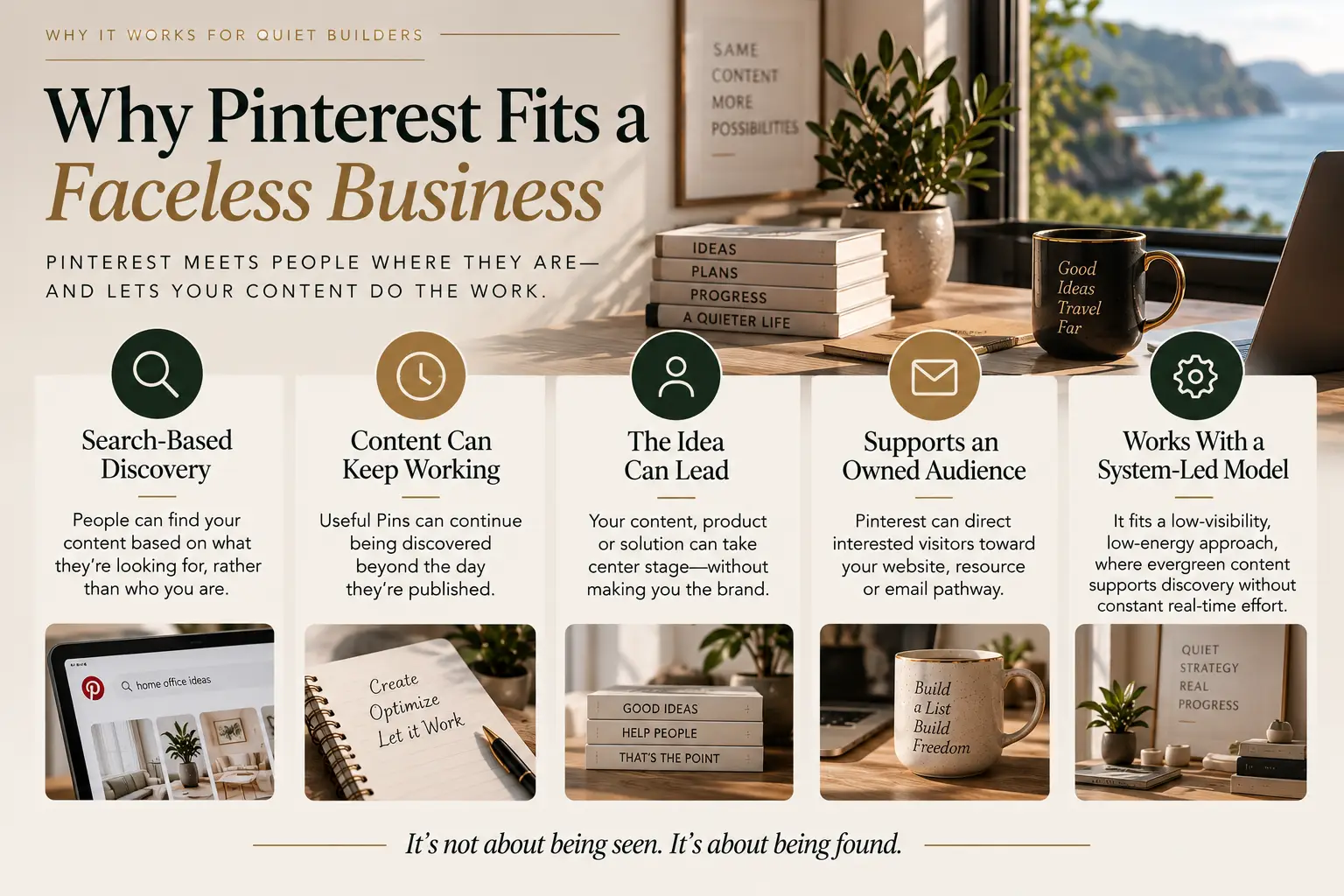
A faceless business already depends on content and offers doing the work that a personal brand would otherwise do elsewhere. Pinterest for a faceless business lines up with that structure in a few concrete ways.
It runs on visual search, not personal following. People use Pinterest to look for something specific, an idea, a product, a solution, far more than to catch up on accounts they follow. That pull-based, intent-driven use pattern means a pin can perform well without anyone knowing or caring who made it.
Nothing about the format requires a face. Pins are built around the content or product itself: an image, a title, a description. There’s no expectation of a profile photo people recognize, a recurring on-camera presence, or a personality driving engagement. A well-designed pin pointing at something useful can work exactly as well from a business account with no personal identity attached as from one with a founder’s face on every image.
Content can keep circulating long after it’s published. A pin doesn’t have the short shelf life of a typical social post. It can continue to surface in search and recommendations well after the day it went up, closer to how a blog post keeps ranking than how a feed post fades within a day or two.
Traffic can be pointed toward owned assets. A pin’s job is usually to move someone off Pinterest and onto something the business actually controls, a blog post, a product page, a landing page, rather than to keep them engaged inside the platform itself.
Creation can be batched instead of performed live. Because a pin isn’t tied to a specific live moment the way a story or a same-day post often is, a set of pins can be designed and scheduled in one sitting. That fits a business with no one available (or willing) to post in real time.
Turning Pins Into an Email List, Not Just a Click
The traffic-to-owned-asset idea is worth going further than “send people to the blog,” because for a faceless business, an email list is often the more valuable destination. A visitor who reads one blog post and leaves is a one-time click. A visitor who joins an email list is a relationship the business can keep reaching without depending on Pinterest, or any platform, showing them anything again.
The mechanism is a lead magnet: something specific and useful enough that a visitor will trade an email address for it, a checklist, a template, a short guide, a mini-course, offered on or right after the page a pin sends someone to. A pin can point directly at a landing page built around that lead magnet, or it can point at a blog post that offers the lead magnet partway through or at the end, which tends to work better when the topic needs some explanation first before the offer makes sense.
Once someone’s on the list, the email sequence that follows is where a faceless business actually gets to build trust without a face doing it live. A short welcome sequence, three to five emails, can do in writing what a founder’s presence would otherwise do in person: explain what the business is for, show a result or an example, and lead naturally toward a paid offer. None of that requires video, a voice, or a recognizable personality. It requires clear writing and an offer that’s actually worth the ask.
This is the structural reason Pinterest for a faceless business can work better than most social platforms: the platform is built to move people toward something else, and an email list is the “something else” that keeps paying off long after the original pin has stopped getting clicks.

What Pinterest Is Not
It’s worth being just as direct about the limits, because oversold claims about this platform are common and most of them don’t hold up.
Pinterest doesn’t guarantee traffic. Publishing pins is necessary, not sufficient. A pin still has to be relevant, well-titled, and pointed at something worth clicking through to.
It isn’t passive. Building a working pin strategy takes real, ongoing setup: researching what people are actually searching for, writing pin titles and descriptions that reflect that, creating pin designs, and organizing boards around topics instead of personal taste.
It doesn’t eliminate the need for consistency. A handful of pins posted once won’t sustain traffic. Regular, batched additions over time are part of how the platform keeps surfacing content as relevant.
It doesn’t produce instant results. Like search generally, Pinterest traffic tends to build over weeks and months, not immediately after a pin goes up.
It doesn’t remove the need for optimization. Pin titles, descriptions, and board organization function similarly to keywords and metadata elsewhere. Skipping that layer and hoping the platform figures it out tends to produce weak results.
And it doesn’t remove the need for a real destination. A well-optimized pin pointing to a thin landing page, an unclear offer, or a lead magnet nobody actually wants will still lose the visitor it worked to earn. Pinterest can only ever be as good as what it’s sending people to.
None of this makes Pinterest for a faceless business effortless. It remains a channel that rewards the same things search-based marketing generally rewards: relevance, usefulness, and patience, not effort measured in hours spent posting.
A Beginner’s Implementation Path
For someone starting from zero, the order matters more than the volume. A rough, realistic sequence:
Start with the destination, not the pin. Before designing anything, get clear on what a click should lead to: a specific blog post, a lead magnet landing page, or a product page. Pinning toward something vague or not yet built wastes the effort regardless of how good the pin design is.
Set up a business account and claim the website. This is a one-time setup step that unlocks basic analytics and confirms ownership of the destination site, both useful once there’s enough activity to review.
Build boards around topics, not aesthetics. Each board should represent a topic or a search intent a real person would have, organized the way a searcher thinks, not the way the business happens to be organized internally.
Write pin titles and descriptions like page titles for search. Around what someone would actually type into Pinterest’s search bar, not around internal branding language that means something to the business but not to a stranger scrolling by.
Design a small first batch, not a full calendar. A handful of pins, maybe five to ten, pointed at one or two pieces of content or one lead magnet, is enough to start. A full content calendar built before anything has been tested tends to produce a lot of pins pointed at the wrong thing.
Treat the first several weeks as setup, not results. Like most search-based strategies, the payoff tends to show up after there’s enough of a pin library built up to start reinforcing itself. Early weeks are for learning what gets clicked, not for judging whether the channel works.
Add a lead magnet before scaling pin volume. Once the first batch is out and pointed somewhere real, building the email capture piece matters more than producing more pins. More traffic to a page with no way to capture it is traffic that leaves without a trace.
How This Fits a Search-Led Strategy Overall
Search-Based Marketing vs Social Media Marketing: What Works Better for Introverts? lays out why someone might choose search-led acquisition as a primary strategy in the first place: lower posting pressure, higher compounding potential, less dependence on constant visibility. Pinterest is one concrete way to run that strategy for visual or highly scannable content, and it pairs particularly well with a blog, since Why Blogging Is Still One of the Smartest Online Businesses for Introverts covers the other half of the same approach: written, evergreen content that a pin can point toward.
Frequently Asked Questions
Is Pinterest social media or a search engine?
Functionally, closer to a search engine, even though it has social-style features like boards and follows. Pinterest has described itself as a visual search engine, and the way people actually use it, searching for something specific rather than browsing accounts they follow, reflects that.
Can Pinterest work for a business with no personal brand or face attached to it?
Yes. Pins are built around the content or product itself, not a recognizable person, which is part of why the platform suits a faceless business better than most feed-based social platforms do.
Do I need to post on Pinterest every day for it to work?
No. Because content isn’t tied to a specific live moment, pins can be created and scheduled in batches rather than daily. Consistency over weeks and months matters more than daily frequency.
How fast does Pinterest traffic typically build?
Gradually, similar to search traffic generally, over a period of weeks to months rather than immediately. There’s no verified shortcut around that build time, and treating early weeks as setup rather than results tends to match reality more closely.
Your Next Step
If there’s no blog post, lead magnet, or offer worth directing Pinterest traffic toward yet, Why Blogging Is Still One of the Smartest Online Businesses for Introverts is the place to build that foundation first. If the goal is to see how a channel like this fits a specific business model, the Quiet Income Starter Kit includes the Business Model Paths that show where traffic and discovery channels fit into a complete plan.
Sources
- Pinterest — Wikipedia: documents Pinterest’s shift toward visual search functionality and its description as a “visual search engine,” cited above to support the search-vs-social framing rather than an unsupported platform claim.