You can start an online business without social anxiety dictating constant visibility or contact. The design choices below show where to lower social demand without pretending customers disappear.
A quick note before anything else: this article isn’t about diagnosing or treating social anxiety, and it isn’t going to pretend to. What it’s about is something narrower and more useful: the fact that a lot of standard online business advice quietly bundles “build a business” together with “perform constant social contact,” as if the two were the same requirement. They’re not. One is the goal. The other is a set of choices about how you get there, and most of those choices can be made differently. For clinical information rather than business design, see the Anxiety and Depression Association of America’s overview of social anxiety disorder.
If the idea of cold DMs, discovery calls, livestreams, or being “on” in comments sections all day sounds less like opportunity and more like a cost you’d rather not pay, this is for you. It also connects to a wider theme covered in How to Stay Private and Still Build Income Online: privacy and low-contact design are two sides of the same decision.
Online Business Without Social Anxiety: Less Contact, Not No Contact
Reduce unnecessary social demand. Do not pretend customers cease to exist. That’s the whole principle, and it’s worth stating plainly because the alternative — a business with zero human interaction, zero trust-building, zero communication — isn’t a real option. It’s a fantasy version of “low contact” that sets people up to feel like they failed when actual customers, actual questions, and actual support needs show up anyway.
What you can genuinely control is how much of that contact is repeated, live, and one-to-one, versus written, automated, and built once. That’s a design decision, made function by function across the business, not a personality trait you either have or don’t.
Redesigning Each Business Function for Lower Contact
Discovery: Let People Find You Instead of Reaching Out to Them
High-contact discovery looks like cold outreach, constant networking, and building visibility through daily social performance. Low-contact discovery relies on search instead: content or listings that answer a question someone is already asking, so they arrive already interested instead of needing to be pursued.
This is slower to build than an outreach campaign and considerably less draining to run once it exists, because a blog post or a well-optimized product listing keeps working without you showing up to restate it. The Low Visibility Business Model goes further into why this trade-off tends to favor introverts specifically.
Sales: Let Your Writing Do What a Call Would Do
High-contact sales usually means a discovery call, a live pitch, back-and-forth negotiation. Low-contact sales means the same information — what this is, who it’s for, what it costs, what happens after purchase — delivered clearly in writing, upfront, with no call required to get an answer.
Done well, a clear sales page or product description removes more objections than a call does, because a reader can revisit it, and because nothing about it depends on you being available at a specific time to explain what you sell. The bar is that it has to actually answer the questions a call would have answered. A vague page that requires a follow-up message to understand isn’t low-contact. It’s just contact deferred to later, with extra friction added.
Delivery: Automate the Handoff
Digital products, scheduled email sequences, self-serve access, and pre-recorded material can all deliver value without a live human moment attached to every transaction. This is one of the more genuinely low-contact structural choices available, and it’s part of why digital products get discussed often in Quiet Income content — not because they’re effortless, but because the delivery mechanism itself doesn’t require repeated presence. Digital Products: The Best Quiet Income Business Model? covers that mechanism in more depth.
Support: Batch It Instead of Living In It
This is the function people most often assume has to be constant — live chat, instant replies, always-on availability. It doesn’t. A clear FAQ page answers the questions that would otherwise become repeat one-to-one conversations. A defined response window (say, replies within one to two business days, stated plainly somewhere a customer can see it) turns support into something you check and handle in a batch, rather than something interrupting you continuously.
None of this means ignoring customers. It means choosing when contact happens instead of being permanently reachable by default.

What Doesn’t Change, Even in a Low-Contact Business
Trust still has to be earned. Customers still need to understand what they’re buying before they buy it. Marketing still has to be honest, not manipulative, about what a product does and doesn’t do. None of the redesign above is a way around those requirements. It’s a way of meeting them without also agreeing to be constantly available, constantly visible, or constantly “on” in front of people.
It’s worth being honest, too, that a fully zero-contact business isn’t realistic for most models. Somebody will occasionally need a refund handled, have a question the FAQ didn’t anticipate, or want a genuine human response before buying. Building in a small, boundaried amount of space for that, rather than promising yourself it will never happen, tends to hold up better than a system that has no plan for it at all.
Setting the Boundary on Purpose
A useful exercise: go through your business, function by function — discovery, sales, delivery, support, and anything else specific to your model — and mark which parts currently require live, one-to-one contact by default rather than by exception. Each one is a candidate for redesign using the pattern above: written instead of spoken, automated instead of manual, defined instead of open-ended, batched instead of constant.
This isn’t about closing yourself off from customers. It’s about making sure the contact that does happen is the kind you chose, at a time you chose, instead of contact that happens to you because the system was never designed with an alternative in mind. If you’re starting from nothing, No Camera, No Followers. Start Here covers the five things you actually need to build before any of this contact question even comes up.
Frequently Asked Questions
Can you actually run a business without networking or calls?
Largely, yes — most of the model’s contact points (discovery, sales, delivery, support) can be redesigned to run asynchronously and in writing. Occasional direct contact still happens; it’s the volume and unpredictability of it that changes, not the total elimination of it.
Is a low-contact business less trustworthy to customers?
Not inherently. Trust comes from clarity, consistency, and follow-through, not from live availability. A clear, honest sales page can build more trust than a rushed call, simply because a customer can read it carefully and come back to it.
What’s the easiest business function to redesign first?
Support, usually. A well-built FAQ page and a stated response window remove a large share of the contact that would otherwise be live and reactive, and it’s the change most businesses can make immediately without touching pricing, product, or marketing.
Your Next Step
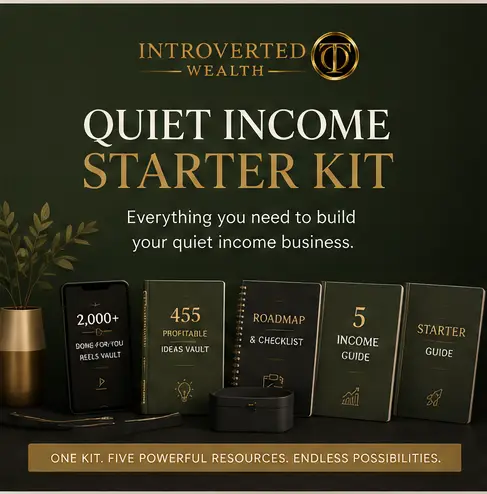
If you’re not yet sure which business model gives you the most natural low-contact structure to build on, the Quiet Income Archetype Quiz is built to narrow that down in a few minutes. If you already have a direction and want the fuller build-out, the Quiet Income Starter Kit includes the Business Model Paths and Roadmap to take this from a design principle to an actual working structure.