Most “best digital products to sell” articles start from the product and work backward to a person: here are twelve formats, pick one. That order gets it backward. The format that will actually get finished — and finished well enough to sell — depends far more on how someone naturally works than on which format is trending this quarter.
This article starts from the person instead, working out the best digital products for introverts by matching format to how each person actually works. Six common working styles, and the digital product formats that tend to fit each one without fighting against the grain.
Working-style self-check
Start with the way you already create value.
You clarify ideas through words.
You turn chaos into order.
You communicate visually.
You enjoy evidence and depth.
You spot and arrange what matters.
You build repeatable processes.
If you’re a writer
Comfortable turning a concept into clear, structured language; the blank page is an opportunity, not an obstacle.
Best-fit products: guides and ebooks, workbooks with written instructional content, email or content swipe files. The core skill — organizing thought into readable, useful language — transfers almost directly into any of these without requiring a second skill set (design, data, research) to feel complete.
Realistic first step: a short guide (15–30 pages) on one specific, narrow problem, rather than a broad topic. Narrow topics finish. Broad topics stall.
If you’re an organizer
Naturally thinks in categories, sequences, and checklists; energized by taking something messy and giving it clean structure.
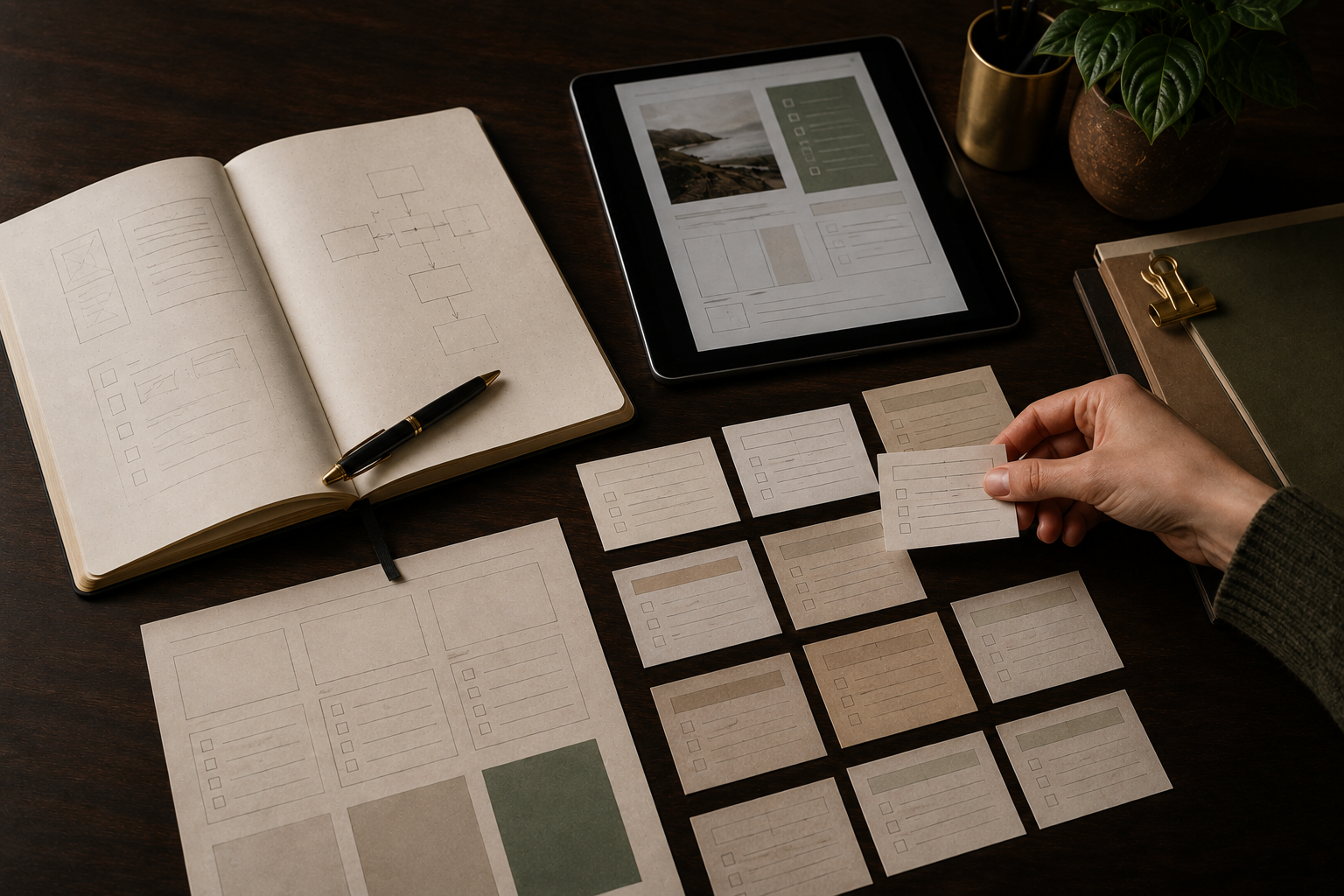
Best-fit products: planners, checklists, project trackers, structured templates for recurring processes. The product essentially is the organizing — buyers are paying for a system already built, so they don’t have to build it themselves.
Realistic first step: pick one process already personally organized well (a moving checklist, a launch plan, a budgeting system) and turn that exact structure into a sellable template.
If you’re a designer
Thinks visually first; can make something look clean, professional, and cohesive without needing to explain why it works.
Best-fit products: Canva template packs, printable planners with strong visual design, branded asset kits. Design-forward products are judged almost entirely on their preview images — this is the working style with the shortest distance between skill and sellable product.
Realistic first step: a tightly scoped template pack (5–10 templates) for one specific use case, rather than a broad “everything” pack that dilutes the visual identity.
If you’re a researcher
Enjoys going deep on a topic, verifying details, and organizing findings into something accurate and comprehensive.
Best-fit products: reference guides, comparison resources, data-backed toolkits. What sells here is trustworthiness and depth — a reference guide that’s genuinely more complete and accurate than the free version scattered across the internet has real, durable value.
Realistic first step: choose one question people search repeatedly and build the single best, most current answer to it — not the broadest topic, the best-answered specific one.
If you’re a curator
Good at finding, evaluating, and organizing existing resources or ideas rather than generating original content from scratch.
Best-fit products: prompt vaults, idea collections, resource roundups, swipe files. The 455 Idea Vault linked below is exactly this format applied to business ideas — curation, organized well, is a real and often underrated product category.
Realistic first step: start a running list of the best 30 examples in a specific category, then organize and package it once the list feels genuinely useful on its own.
If you’re a systems thinker
Sees processes and structures other people miss; drawn to building the underlying logic of how something should work, not just the surface content.
Best-fit products: spreadsheets and calculators, multi-step frameworks, structured templates with built-in logic (formulas, decision trees, scoring systems). This working style tends to produce the most defensible products on this list, since the underlying system is genuinely harder to copy than static content.
Realistic first step: build the calculation or framework for personal use first, then package the working version — systems built to solve a real problem tend to be more useful than ones designed for a hypothetical buyer.
Strength-to-product matrix

Match your natural work to a useful format.
| Working style | Best-fit formats | Realistic first step |
|---|---|---|
| Writer | Guides, workbooks, scripts | Outline one narrow outcome |
| Organizer | Planners, trackers, templates | Map a repeatable weekly process |
| Designer | Canva kits, mockups, printables | Build a 5–10-template mini pack |
| Researcher | Reports, reference guides | Answer one costly question |
| Curator | Vaults, swipe files, directories | Collect 30 vetted resources |
| Systems thinker | SOPs, dashboards, toolkits | Document one workflow |
None of these require a personal brand to get started
Every format above can be judged largely on the product itself — its usefulness, clarity, and craftsmanship — rather than on who made it or how many people follow them, though an existing audience can still make early sales easier. You Don’t Need a Personal Brand to Make Money Online makes this case in full; this article is really an applied version of that argument, format by format.
Working style is a starting point, not a cage
This list of the best digital products for introverts assumes one dominant style, but most people carry a primary working style with real traits from a second — a researcher who also organizes well, a writer who also designs competently. That’s normal, and it usually means more than one row on the matrix above is genuinely viable. What matters more than picking the “correct” style is picking a format that won’t fight against natural tendencies for months before producing anything sellable.
For the wider view of how digital products compare to other Quiet Income models, Digital Products: The Best Quiet Income Business Model? and Choosing the Right Quiet Income Business Model both go further than working-style fit alone. And before building anything from this list, Biggest Mistakes New Digital Product Creators Make is worth a read — most first-product regret comes from skipping validation, not from choosing the “wrong” format.
Start here
Choose your style, then choose one small proof.
Pick the working style that felt most familiar, use its realistic first step, and create the smallest useful version this week.
For anyone who wants a fuller starting framework before committing to one of the best digital products for introverts, The Quiet Income Blueprint is the broader resource this article sits inside of.
FAQ
What are the best digital products for introverts to sell?
The best digital products for introverts to sell are the ones that fit how you already work: guides and workbooks for writers, templates and trackers for organizers, Canva kits for designers, data-backed reports for researchers, curated digital products for curators, and calculators or frameworks for systems thinkers. Match the format to your working style first, then pick a specific idea from the list above.
What if I don’t fit neatly into one working style?
Very common — most people are a blend of two. Start with whichever style feels like the strongest, most natural default, since that’s usually the one that will actually get a first product finished.
Which digital product format is easiest to start with?
Curated formats (prompt vaults, resource lists) and organizer formats (checklists, templates) tend to have the shortest path from idea to finished, sellable product, since they lean on existing skill rather than requiring a new one to be learned first.
Do I need special software to create any of these?
No — Canva’s free tier covers design-forward and organizer products, and Google Sheets covers most systems-thinker products. Specialized software can help later, but isn’t a requirement to launch a first version.
Your next quiet move
Turn your working style into a sellable direction.
Use the Idea Vault to move from one natural strength to a focused product concept.
Whichever of the best digital products for introverts you choose, keep it simple: pick one working style that matches how you actually operate, one narrow problem worth solving, and one smallest useful product you can finish. If you want a shortcut to that first choice, the free Archetype Quiz is a quiet next step — but the Idea Vault above is where the actual building starts.