QUIET INCOME FRAMEWORK
You have done everything the productivity advice told you to do. You built a content calendar, batched your tasks, automated your emails, and still—by Thursday—you are running on fumes. That is not a discipline problem. It is usually a design problem: your business is asking for more energy than it was ever built to give back.
The low energy business model is not about doing less work. It is about building a business that does not quietly drain you just to stay running.
Low energy does not mean low ambition, low income, or low output. It means your business is designed so that its day-to-day maintenance does not outpace your capacity to sustain it. You can still build something substantial. You just stop paying for that growth with your attention, your nervous system, and your ability to think clearly.
AT A GLANCE
The low energy business model reduces unnecessary recurring demands—constant posting, live performance, manual repetition, and reactive availability—so a business can grow without requiring more of your energy every time it grows.
What is a low energy business model?
A low energy business model is a way of designing your work so that its ongoing maintenance costs less attention over time, not more. It asks a simple question before adding anything new: does this require my energy every single day, or can it be built once and left to work?
This sits naturally alongside the Quiet Income Blueprint. Quiet income already assumes lower visibility and more leverage. Low energy is the part of that framework that protects the person actually running the business—not just the systems around them.
Energy, in this sense, is not only about hours. It includes the mental load of constant decisions, the pressure of staying visible, and the fatigue of switching between too many types of work in a single day.
Low energy is not the same as low effort
It is worth being direct about what this model is not. A low energy business still requires real work: writing that holds up, offers that solve a genuine problem, and systems that are built with care instead of shortcuts. What changes is where that effort goes.
In a high-maintenance business, effort is spent over and over on the same tasks—another post, another live update, another manual follow-up. In a low energy business, effort is spent once, upfront, on something that keeps working after you stop actively touching it. The total work does not disappear. It moves from repeated to built.
| High-maintenance model | Low-energy model |
|---|---|
| Growth requires more daily output | Growth is supported by existing assets |
| Momentum depends on constant presence | Momentum continues during rest and downtime |
| Every new offer adds new manual tasks | New offers reuse existing systems where possible |
| Energy is spent reactively, all day | Energy is spent in focused, contained sessions |
| Stepping away creates visible gaps | Stepping away is absorbed by the system |
Neither column describes a lazy business or an ambitious one. They describe two different relationships between your output and your energy. The low energy model simply refuses to let the two rise together forever.

Five signs your business is heavier than it needs to be
- You dread your own maintenance tasks. Not the creative work—the upkeep: reposting, re-explaining, re-sending the same message by hand.
- Every offer needs your live involvement. If you disappeared for two weeks, delivery would stop entirely.
- Your calendar is full of small, constant interruptions. Nothing individually large, but nothing ever fully closes either.
- Rest feels like falling behind. A day off costs you visibility, momentum, or income in a way that feels disproportionate.
- You keep adding tools to manage a workload that tools cannot fix. The problem is not the platform. It is what the business is structurally asking of you.
None of these signs mean you have built the wrong business. They usually mean a few specific parts of it were built for someone with a different energy budget than yours.
This pattern is well documented outside the entrepreneurship world too. The American Psychological Association’s burnout research resources describe how chronic workplace demands and insufficient resources can contribute to burnout. A low energy business model applies a similar design question to entrepreneurship: are the demands of the business sustainable with the resources and capacity available?
The five parts of a low energy business
01. A contained core offer
A low energy business usually centers on a small number of offers built well, rather than a wide spread of options that each need their own upkeep. Depth costs less ongoing energy than breadth.
02. Systems that outlast a single session
Email sequences, templates, saved responses, and pre-built delivery steps let a task you would otherwise repeat by hand happen automatically once it is set up.
03. Batched, not constant, creation
Work is grouped into focused sessions with real starts and ends, instead of being spread thin across every day in small, draining pieces.
04. Boundaries around availability
Response times, office hours, and support scope are decided in advance—not negotiated in real time, every time, under pressure.
05. Built-in recovery
Slower weeks, buffer days, and lighter seasons are planned into the business model itself, not treated as failures to apologize for.
None of these parts require expensive tools or a large team. They require deciding, in advance, what your business is allowed to ask of you on an ordinary Tuesday.
Why this matters more for introverts and quieter founders
Introverts are not incapable of hard work, long hours, or high output. Many do their best thinking in exactly those conditions. What tends to drain an introverted founder faster is not effort—it is unstructured exposure: constant availability, real-time performance, and switching contexts all day without any contained recovery.
A low energy business model does not remove ambition. It removes the parts of the workload that were never actually about the work—the parts that existed only to keep up appearances of constant activity.
If visibility itself is part of what feels heavy, the companion article on the low visibility business model looks at that side of the equation directly. The two are closely related: visibility affects how often you are seen, and energy affects how much each of those moments costs you.

Does a low energy business model mean earning less?
Not by design. A low energy business model does not cap your income—it changes what has to happen for that income to grow. In a high-maintenance model, more revenue usually means more manual work: more posts, more live sessions, more one-on-one handling. In a low energy model, more revenue is meant to come from what you already built working harder on your behalf, not from you working harder yourself.
That does not happen automatically or overnight. Systems still need to be built thoughtfully, offers still need to be genuinely useful, and some seasons will ask more of you than others. What the model changes is the long-term relationship between your effort and your results—so growth stops being something you have to personally re-earn every single week.
How to begin lowering your business’s energy demand
You do not need to redesign your entire business this week. Start by identifying the single task that drains you the most relative to what it actually produces. That is usually the clearest place to begin.
Turn a repeated manual message into a saved template. Turn a live explanation you give often into a written resource you can simply send. Turn an offer that requires your constant presence into one that can be delivered with a system behind it. Each small shift frees up energy that can go toward the parts of the business only you can do.
Small, sustainable adjustments compound the same way owned assets do—quietly, and over time.
DESIGN A BUSINESS THAT MATCHES YOUR ENERGY
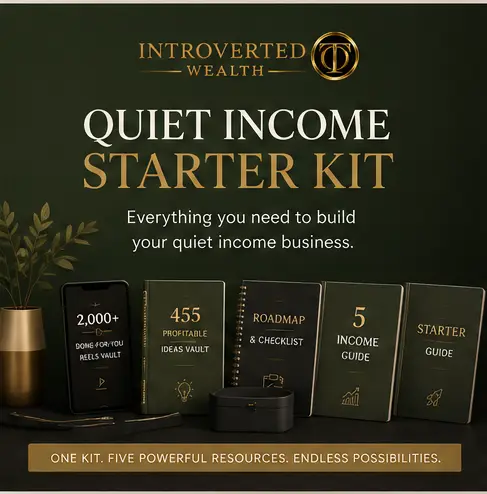
Use the Business Match Assessment to see which Quiet Income path fits your energy, visibility, and working style. Then use the Quiet Income Starter Kit to turn that direction into a practical, low-maintenance plan.
The goal is a business you can sustain, not just start
A low energy business model is not a smaller version of ambition. It is a more honest one—built for the energy you actually have, not the energy you feel you are supposed to perform. When the maintenance cost of your business stops rising every time it grows, you get to keep more of your attention for the work that matters, and for the life the business was supposed to support in the first place.
Continue reading: revisit The Quiet Income Blueprint, or see how Introverts Build Businesses Differently.