

Somewhere between “follow your passion” and “build in public,” online business advice quietly started requiring something a lot of people never signed up for: giving up their privacy. Your face, your voice, your daily life, your opinions — all treated as raw material for the business.
If the idea of trading your privacy for income makes you want to close every tab and walk away, here’s the part that advice usually skips: you don’t have to make that trade. It’s entirely possible to stay private and still build real income online.
This isn’t about hiding or being secretive. It’s about recognizing that visibility and income are two separate things that online culture has taught us to treat as one.
In This Article
Why Privacy and Income Feel Incompatible
Most of the loudest online business advice comes from people who are comfortable being public — creators, influencers, coaches who built their income by building an audience around themselves. Their advice isn’t wrong for them. It’s just being generalized to everyone, including people for whom visibility isn’t just uncomfortable, it’s actively costly.
Privacy concerns aren’t a small, quirky preference. They can be about safety, about a separate professional life, about family circumstances, about simply not wanting your name searchable next to your business forever. All of those are legitimate reasons to want income without exposure — and none of them have to stop you.
What Actually Requires Visibility (And What Doesn’t)
It helps to separate what genuinely requires you to be visible from what just looks that way because it’s the most common approach:
- Requires visibility: being a public speaker, an on-camera coach, or a creator whose personal story is the product itself.
- Doesn’t require visibility: selling digital products, running a theme page, writing SEO content, affiliate marketing, print on demand, or any business where the product — not the person — does the selling.
Most people default to the visible path simply because it’s the one they see modeled the most, not because it’s the only one that works.
Business Models That Protect Your Privacy
- Digital products sold under a brand name. Templates, planners, and guides can sell entirely on their own merit, with a business name attached instead of yours.
- Faceless theme pages and niche content. Built around a topic, not a personality — no name, face, or personal disclosure required anywhere in the process.
- SEO-driven blogging. Search traffic doesn’t require an audience to already know who you are — it just requires content that answers a question well.
- Affiliate marketing through written content. Recommending tools you use, without needing to appear on camera or build a personal following first.
Public-Facing Brand
- What’s visible
- A brand name, an offer, and a body of work — fully public.
- What stays private
- Your face, your name, your daily life, and your location.
- How trust is built
- Product quality, reviews, SEO, and consistency.
- What customers need to know
- That the business is legitimate and reliable — not who runs it.
Private Person
- What’s visible
- Nothing customer-facing — no name, face, or personal story attached.
- What stays private
- Everything — your identity is never part of the offer.
- How trust is built
- The same signals, just without a personal presence layered on top.
- What customers need to know
- Nothing about you personally — and they generally don’t ask.

Privacy and income aren’t opposites. They’re just two different design choices — and you get to choose both.
Practical Ways to Stay Private Online
Register under a brand or studio name, and avoid using your face or full name in marketing materials unless you choose to later.
Keep your personal story out of the business narrative — let the product and results do the talking instead.
There’s no need to publish your exact home location — a business address or virtual mailbox covers most needs.
Use a separate business email, and keep personal and business social accounts fully separate — don’t cross-link them.
Decide in advance how quickly you’ll respond to messages, and hold that line — you don’t owe real-time availability.
Choose which platforms you show up on deliberately, review what’s publicly searchable about your business periodically, and use CISA’s small-business security guidance to strengthen the accounts and systems behind the brand.

Staying private publicly does not mean staying anonymous everywhere.
One honest caveat: staying private publicly does not mean staying anonymous everywhere. Payment processors, banks, and tax authorities will still require your real legal information to process payments and file taxes correctly — that is a legal requirement, not a privacy failure. What you are protecting is your public-facing identity, not your compliance with the systems that keep a business legitimate.
What You Give Up, and What You Don’t
Staying private isn’t free of tradeoffs, and it’s worth naming them honestly. You give up the trust-shortcut that comes from an audience feeling like they know you personally, and you may need to rely more on reviews, SEO, and product quality to build that trust instead.
What you don’t give up is the ability to build something real. Faceless and private businesses generate genuine, sustainable income every day — the privacy is a design choice, not a ceiling on what’s possible.
Trust Without Oversharing
None of this requires anyone to guess who they’re buying from. It requires a handful of concrete signals — built consistently — to do the trust-building instead:
Clear Offer
State exactly what the product or service does and who it’s for — clarity does more trust-building than personality ever could.
Useful Content
Content that solves a real problem earns trust on its own, without needing a face behind it.
Proof
Reviews, testimonials, and results show a business works, without requiring anyone to know who runs it.
Consistency
Reliable quality and a steady brand presence build familiarity even without a personal one.
Policies
Clear refund, delivery, and contact policies read as trustworthy to any first-time visitor.
Customer Support
Responding quickly and personally to questions builds trust just as well as a face-to-face interaction would.
How to Start This Week
Four steps to build without exposure
- Pick a brand name that isn’t yours. Even a simple studio name creates useful separation from day one.
- Set up a separate business email. This alone prevents most accidental cross-contamination between personal and business identity.
- Choose one privacy-friendly business model to start. A digital product or a theme page are both low-visibility ways to test the waters. Still deciding which model fits you? The Business Match Assessment can help you figure that out first.
- Decide your visibility boundary in advance. Knowing what you will and won’t share ahead of time makes it much easier to hold that line later.
Common Questions
Can a completely anonymous business actually succeed?
Publicly, yes — many successful digital product shops, theme pages, and content sites operate under a brand name with no personal identity attached at all, and trust comes from product quality, reviews, and consistency instead of personal familiarity. Behind the scenes, your payment processor, bank, and tax authority will still need your real identity — “anonymous” here means anonymous to your customers, not invisible to the systems that keep a business legal.
Do customers care if they don’t know who’s behind a business?
Generally, less than you’d expect. Most customers care about whether the product works and whether the business is responsive and reliable — not whether they know the founder’s name or face.
Is staying private the same as being untrustworthy?
No. Privacy and trustworthiness are unrelated. Clear policies, responsive support, and consistent quality build trust regardless of how visible the person behind the business is.
What if I want privacy now but might go public later?
That’s a completely reasonable approach. Starting private keeps your options open — it’s much easier to add visibility later by choice than to walk it back after the fact.
The Bottom Line
You don’t owe the internet your visibility in exchange for income. Privacy is a design choice, and it’s one you’re allowed to make.
Staying private doesn’t mean staying small. It means building on a foundation that doesn’t require you to trade your personal life for your income — which is exactly the foundation we map out in The Quiet Income Blueprint.
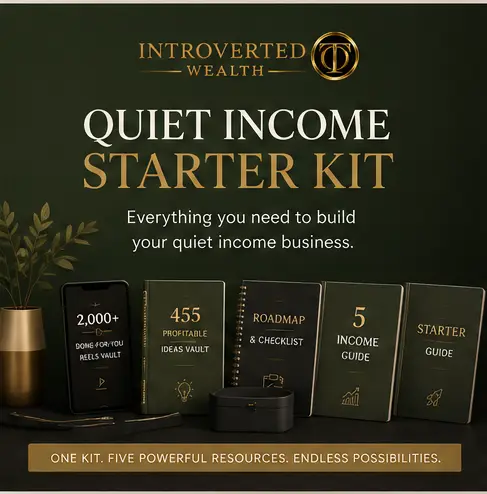
If privacy matters to you and you want a clear starting point, check out the Quiet Income Starter Kit. It walks you through low-visibility business models, digital product ideas, and a step-by-step roadmap designed for introverts.