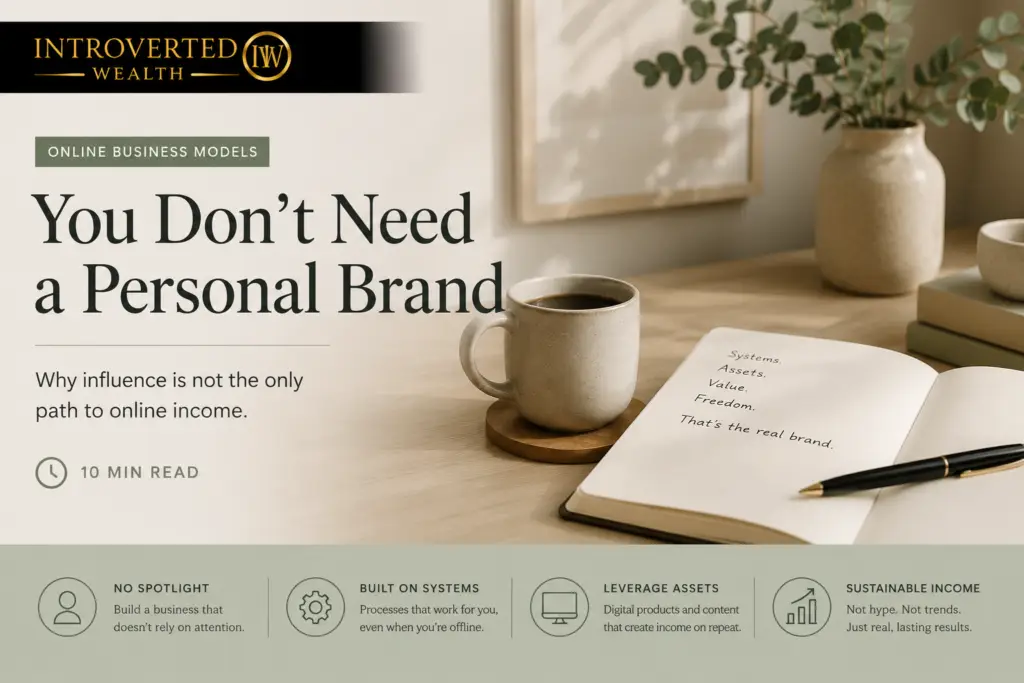
Somewhere along the way, “build a personal brand” became the default answer to almost every online business question. Want to sell a product? Build a personal brand first. Want to grow an audience? Personal brand. Want to be taken seriously? You guessed it — personal brand.
If that advice makes you want to close the laptop and do something else with your life, you’re not alone, and you’re not wrong to feel that way. A personal brand is one way to build an online business. It is not the only way, and for a lot of people, it’s not even a good way.
You can make real money online without becoming the face of your business. Here’s why that advice got so loud, why it doesn’t apply to everyone, and what to build instead.
In This Article
The Personal Brand Myth
The personal brand advice isn’t wrong for everyone — it’s just wrong as a universal rule. It got popular because it genuinely works well for a specific kind of person: someone who enjoys being visible, who finds an audience energizing rather than draining, and who is comfortable being recognized in public as the person behind the business.
The problem is survivorship bias. You see the creators whose personal brand took off and assume that’s simply what building an online business looks like. You don’t see the much larger number of people who tried to build a public persona, found it exhausting or anxiety-inducing, and quietly gave up — not because their business idea was bad, but because the delivery method was wrong for them.
A personal brand, in its original sense, is simply the practice of marketing yourself and your career as a brand. Somewhere along the way, that got flattened into “post your face online constantly,” which is a much narrower and much more demanding version of the idea.
What “Personal Brand” Actually Means
A personal brand ties a business’s trust, recognition, and growth directly to one identifiable person — their face, their voice, their story, their day-to-day life. When it works, it works well: people feel like they know you, and that familiarity shortcuts the trust-building process.
But that shortcut has a cost. Your business becomes dependent on your continued visibility, your continued willingness to share, and your continued comfort being recognized. If any of those change — you get tired, you want privacy back, your circumstances shift — the business can wobble along with you.
None of that is a flaw in you. It’s a structural feature of building a business around a personal brand. The alternative isn’t “no brand” — it’s a brand that isn’t load-bearing on your personal visibility.
Personal-Brand-Dependent Business
- How trust is built
- Recognition and familiarity with one visible person.
- What growth depends on
- Continued content, continued visibility, continued audience-building.
- Public exposure required
- High — face, voice, and often personal life on display.
- What happens if you step back
- Visibility drops, and momentum often drops with it.
- Main risk
- A single point of failure — the business is only as available as you are.
Brand-Led / Asset-Led Business
- How trust is built
- Usefulness, consistency, proof, and clear positioning.
- What growth depends on
- Discoverability — search, reviews, and a product that delivers.
- Public exposure required
- Low — the offer and the brand carry the weight, not a face.
- What happens if you step back
- The systems and assets keep working without you on camera.
- Main risk
- Slower initial trust-building, since there’s no shortcut through personal familiarity.

Why You Don’t Need One
- Buyers care about the outcome, not the founder. Someone buying a template, a planner, or a course wants the result it promises. They rarely need to know your face to trust that the product will do what it says.
- Trust can come from other signals. Reviews, testimonials, clear policies, professional design, and consistent quality all build trust independently of any one person’s visibility.
- Visibility has real costs. Public scrutiny, comparison, privacy loss, and the pressure to constantly perform a version of yourself are genuine costs that rarely get mentioned in “just be authentic online” advice.
- It creates a single point of failure. A business built entirely around one person’s personal brand is fragile in a way a systems-and-product-based business isn’t — it can’t easily be paused, delegated, or stepped away from.
You don’t need to be known to be trusted. You need to be consistent, clear, and good at the thing you’re selling.
What Works Instead of a Personal Brand
If your face isn’t doing the trust-building, something else needs to. Here’s what actually fills that gap for faceless and low-visibility businesses:
A Strong, Specific Niche
A business that clearly serves one kind of person with one kind of problem builds trust through relevance, without needing a personality attached.
Product Quality & Positioning
Good design, clear copy, and a product that does what it promises does more long-term trust-building than any amount of visibility.
A Studio or Brand Name
Plenty of successful digital product shops and theme pages operate under a business name, not a founder’s name — and buyers rarely notice or care.
Search & Platform Discovery
SEO-driven blog content, Pinterest, and marketplace placement can all bring in buyers without requiring anyone to build a following first. This is part of what we cover in The Quiet Income Blueprint.
Reviews & Social Proof
Once you have even a handful of genuine reviews or testimonials, they do a lot of the trust-building work a personal brand would otherwise carry.

None of this requires total anonymity — a lighter-touch personal presence can still coexist with a low-visibility brand; it’s a spectrum, not an all-or-nothing choice. If you want to see what earning without constant personal performance looks like in practice, How to Make Money Without Being an Influencer covers that in more depth.
How to Build Trust Without Being the Face
- Write clear, honest product descriptions and policies — ambiguity is what erodes trust fastest, not anonymity.
- Invest in visual design and branding consistency, since it’s often the first trust signal a visitor sees.
- Collect and display reviews or testimonials as early and often as you reasonably can.
- Respond to customer questions and support requests quickly and personally, even if you never show your face publicly.
- Keep your policies (refunds, delivery, contact) easy to find — visible policies read as trustworthy even to first-time visitors.
How to Start This Week
Four steps, no camera required
- Separate the business from your identity, on paper. Give it a name that isn’t yours, even if you’re the only person behind it right now.
- Pick one trust signal to build first. Reviews, a clean product page, or a clear refund policy — not all three at once.
- Write toward your niche, not toward an audience. Content that serves a specific problem builds trust faster than content trying to build a following.
- Let the product carry the weight. If you’re unsure whether something needs your face attached to sell, default to no, and let the work speak first.
Common Questions
Can you really build a profitable business with zero personal brand?
Yes. Faceless theme pages, digital product shops, affiliate content, and niche blogs all routinely operate profitably without any personal brand attached. The tradeoff is that you lean more heavily on product quality, SEO, and other trust signals instead of personality-driven marketing.
Will I eventually need to show my face to grow?
Not necessarily. Growth can come from search traffic, platform discovery (like Pinterest), reviews, and word of mouth just as easily as from a personal following. Some businesses do eventually add a public-facing element, but it’s a choice, not a requirement — and if staying private is the priority, How to Stay Private and Still Build Income Online covers what that looks like in practice.
Isn’t a personal brand better for building trust faster?
It can shortcut trust-building in the short term, but it also makes the business dependent on your continued visibility. Trust built through product quality, reviews, and clear policies takes a little longer to establish but doesn’t disappear the moment you step back.
What if I already have a personal brand — should I drop it?
No reason to. This isn’t an argument against personal brands, it’s a reminder that they’re optional. If you already have one and enjoy it, keep going. If you don’t have one and have been feeling like you’re failing for not building one, that’s the pressure this article is pushing back on.
The Bottom Line
A personal brand is a tool, not a requirement. Use it if it fits you — build around it if it doesn’t.
The advice to “build a personal brand” usually comes from people for whom visibility is easy, even energizing. If that’s not you, it doesn’t mean you can’t build a real business online — it means you need a different foundation to build it on.
That foundation — low visibility, low energy, real leverage — is exactly what we map out in The Quiet Income Blueprint.
If you’re ready to build something that doesn’t depend on your face or your following, start with the Quiet Income Starter Kit. It walks you through business models, digital product ideas, and a step-by-step roadmap designed for introverts.